That statement still catches people off guard. Leaders I speak with often assume that fractional means less ownership, less continuity, less longevity. I understand the instinct, but it doesn't match my experience. Not even close.
The reality of our fractional leadership team
Here's what tenure on a flexible basis actually looks like at Expert360:
Head of Marketing: 5 years
General Counsel: 9 years
COO: 6 months
CFO: 1 year
And we actually have a second fractional CFO who is more transaction-focused, and they've been with us for 4 years.
These aren't temps. These aren't consultants parachuting in for a quick fix. These are leaders who know our business inside and out.
They just happen to work with us on a flexible basis rather than sitting in a chair five days a week.
Why the fractional model works, for both sides
This is a flexibility that works for both of us as the company evolves through different priorities: growth, transactions, operational efficiency, international expansion.
The nature of what we need from our leadership team shifts, and this model lets us shift with it.
Our fractional leaders spend part of their time with other clients, and we benefit from the energy and insights they bring back. They're not siloed inside a single organisation's way of thinking.
They're pattern-matching across industries, seeing what works elsewhere, and bringing that perspective to our table.
The uncomfortable truth about full-time executive hiring
What people are starting to realise is this: the bar and risk of hiring a full-time leader into the top ranks of an organisation is higher than it has ever been.
The world is getting more uncertain.
Markets move faster, priorities evolve, and the strategic needs of a business can look completely different in twelve months.
And yet the need for high-performing executives has never been greater.
Think about what you're really signing up for when you hire a full-time leader. You need to get confident that this individual can evolve to be everything, for everyone, at every time, at every phase, and that the organisation will continue to need them, until, well, forever.
Because your commitment to them runs until they quit, are managed out for performance, or are made redundant.
That's an enormous bet in a world where certainty is in short supply.
This isn't an either/or conversation
I want to be clear: I have a full-time permanent contract myself, and we regularly hire full-time permanent people, for ourselves and for our clients. Full-time hires absolutely have their place.
But with the world where it is, you probably don't have time to slow down. What you do have time for is to reconsider *how* you bring in your people.
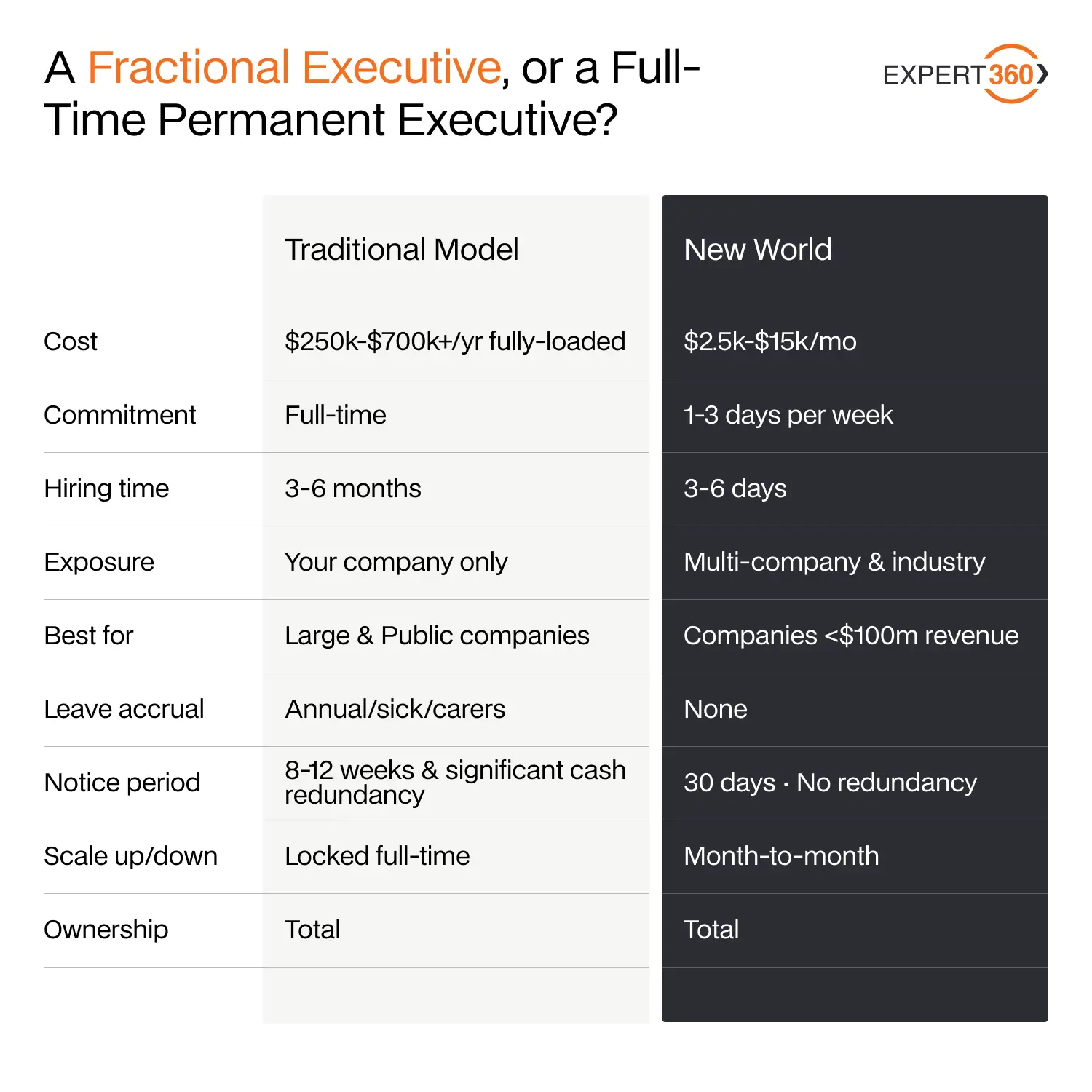
How traditional hiring compares to the new model of fractional hiring
That last row matters. Ownership is total in both models. The difference is everything else: the cost structure, the speed, the flexibility, and the risk profile.
The option that didn't exist before
This option wasn't available at scale in a systematic way before Expert360. But it's what we do every day.
We match companies with exceptional fractional and flexible leaders who are ready to step in, take ownership, and deliver, without the overhead, delay, and rigidity of a traditional executive hire.
If you'd like to see what a fractional alternative could look like for your organisation, we'd love to share ideas, and introduce you to individuals ready to take on a new challenge.



.jpg)